Views: 0 Author: Site Editor Publish Time: 2025-06-18 Origin: Site
As businesses grow, so do the complexities of their logistics operations. From increasing order volumes to introducing automation technologies, warehouse systems must adapt swiftly to stay competitive. A well-designed box conveyor system is not just a short-term investment—it is a scalable infrastructure that evolves with your business. At Zhejiang Rigor Logistics Technology Co., Ltd., we design box conveyor systems that support operational agility, reduce downtime during transitions, and allow for expansion without complete overhauls.
Designing a scalable box conveyor system starts with a clear understanding of your product flow, packaging variables, and facility environment. By answering a few fundamental questions early on, businesses can ensure the system is built with flexibility in mind.
One of the most critical factors is defining the minimum, average, and maximum dimensions of the boxes being transported. This helps determine the roller spacing, belt width, and support structure needed. An undersized design may cause boxes to jam or fall between rollers, while an oversized setup may be unnecessarily costly.
Handling fragile goods requires smooth transitions, slower speeds, and sometimes cushioned surfaces. This affects the choice between belt and roller conveyors, as well as the types of transfer units and accumulation zones.
Is the conveyor going into a dry distribution center, a cold-storage facility, or a high-humidity packing room? Environmental conditions significantly influence material selection. At Zhejiang Rigor Logistics Technology Co., Ltd., we offer frame structures made of carbon steel with surface coating for standard conditions and customizable components for refrigerated or high-dust environments.
If your warehouse is multi-level, you'll need to determine the height changes and required incline angles to plan for elevators or vertical box conveyors, ensuring safe and smooth vertical movement.
Scalable conveyor systems must account for the full range of operational speeds, not just daily averages. Many warehouses experience peak seasons—holidays, promotions, or back-to-school periods—when demand surges significantly.
It’s essential to design the conveyor to handle peak cartons-per-minute (CPM), not just average throughput. Underestimating capacity may result in backlogs, damaged goods, and missed deadlines. For example, a system handling 30 cartons per minute during regular weeks may need to scale up to 60 during busy seasons.
This requires integrating faster conveyor sections, parallel lines, or accumulation zones that temporarily hold parcels until downstream equipment is ready. Buffering helps absorb demand spikes without system strain.
Box conveyors with zero-pressure accumulation zones are excellent for dynamic conditions. These zones temporarily hold boxes without collision, allowing operators or downstream machines to catch up during high-load periods. We at Zhejiang Rigor Logistics Technology Co., Ltd. emphasize the inclusion of buffer points in every scalable layout.
True scalability relies on modularity. Each conveyor component should be adaptable, replaceable, and easy to upgrade as your operations evolve.
Modular roller conveyors allow you to add or remove sections as layout changes. Our box conveyor systems use standard roller modules that snap into existing lines without interrupting service. This plug-and-play approach reduces both cost and downtime.
Belt conveyors, when designed with segmented drives and tension zones, can be expanded or split into multiple lanes to support growing workflows. Belt tension and material strength should match the potential load requirements of future use.
Key scalability features include accumulation conveyors that act as buffers and merge/divert zones that redirect packages intelligently. These allow for flexible routing based on current demand, shifts in station usage, or unexpected slowdowns.
Whether handling a hundred or a thousand packages per hour, the right components make your system future-ready.
The modern warehouse is increasingly reliant on automation, including robotics arms, Automated Mobile Robots (AMRs), and warehouse execution systems (WES). Your box conveyor system must not only accommodate this but anticipate it.
Scalability now includes tech readiness. If your operation plans to adopt robotic palletizers or automated sorting in the near future, conveyor layout should accommodate these interfaces from day one. Height-adjustable stations, robotic handoff points, and compatible software control systems are essential.
Zhejiang Rigor Logistics Technology Co., Ltd. provides conveyor systems that integrate with sensors, PLC controls, and remote diagnostics—ensuring seamless cooperation with both robotic arms and AMRs.
As robotic systems take on a more flexible role in the warehouse, conveyors must adapt in real time. Dynamic reconfiguration—such as rerouting boxes to available robots or balancing loads between pick stations—is possible only when the conveyor system is designed for it from the ground up.
Our smart control systems offer zone-based control and allow for real-time adaptation, enhancing operational continuity even as workflows change.
Often overlooked, the physical and digital infrastructure supporting your conveyor system plays a critical role in scalability.
Power distribution must support modular expansion. Each conveyor segment should be powered individually or in logical zones so that new additions don’t overload the system. Similarly, PLC and HMI systems should be selected with future inputs and outputs in mind.
Zhejiang Rigor Logistics Technology Co., Ltd. provides PLC control cabinets and electrical systems pre-configured for upscaling. Our teams ensure that each installation includes capacity for future device connections and conveyor sections.
Scalable systems may add more weight and vibration to your warehouse floor. Before installation, it’s important to assess floor load capacity and plan for anchoring points and cable trays. Lift systems such as vertical box conveyors must be supported by dedicated frames that won’t interfere with future expansions.
Growth-friendly systems allow for easy access to belts, rollers, and motors. This reduces downtime during repairs and makes upgrades simpler. We design with service aisles, quick-access panels, and belt-lift mechanisms to facilitate preventive maintenance even in tightly packed layouts.
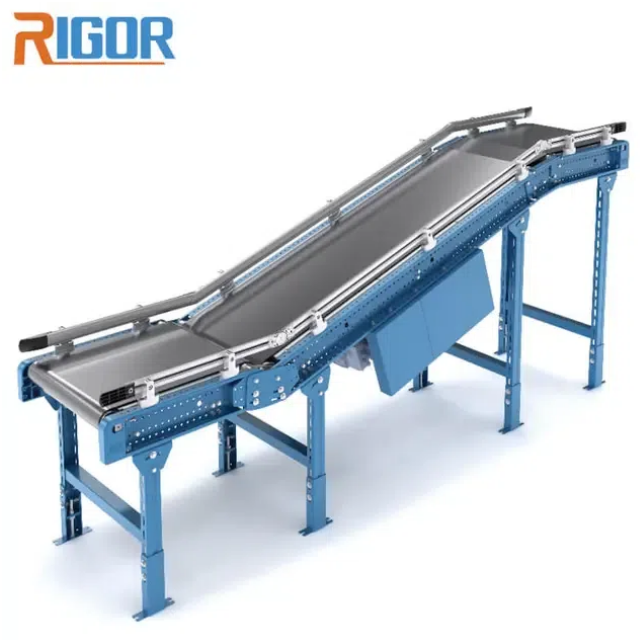
Scalability is not an option—it’s a necessity for any logistics operation aiming to stay ahead of market demands. A well-designed box conveyor system enables businesses to expand, adapt, and modernize without constant reinvestment. At Zhejiang Rigor Logistics Technology Co., Ltd., we specialize in building flexible, modular conveyor systems that not only meet your current needs but also prepare you for the future.
Contact us today to discuss how we can help your business grow with intelligent, scalable conveyor solutions. Let us be your long-term partner in logistics success.


