Views: 0 Author: Site Editor Publish Time: 2025-10-29 Origin: Site
Have you ever wondered how to move materials efficiently across multiple levels in a warehouse? The challenge of transporting goods vertically is solved with incline conveyors. These essential systems improve material flow, reduce manual labor, and maximize space utilization.
In this article, we will explore how customized inclined belt conveyors can enhance your warehouse operations, addressing unique needs and boosting efficiency. You will learn about their benefits, customization options, and key considerations for selecting the best conveyor system for your warehouse.
One of the most significant advantages of inclined belt conveyors is their ability to save valuable floor space. Traditional methods of vertical transport, like lifts or cranes, often require large floor areas to operate efficiently. Inclined conveyors, however, make the best use of vertical space, allowing warehouses to move materials between floors without taking up excessive horizontal space.
For instance, in a warehouse with multiple levels, an inclined conveyor can move goods between a mezzanine and the ground floor, freeing up room for other critical tasks. By utilizing a compact footprint, these conveyors help warehouses maximize storage and operational efficiency, reducing the need for additional equipment and the space it would occupy.
In environments where space is limited, this ability to minimize the conveyor’s footprint becomes a key factor in designing a streamlined, efficient facility. Space-saving solutions like inclined conveyors are especially important in industries where maximizing storage and reducing operational congestion are crucial.
Inclined belt conveyors are designed to provide a continuous and smooth flow of materials. With minimal interruptions in the material handling process, goods can move quickly and efficiently from one point to another. This reduces bottlenecks and delays in warehouses, improving throughput and operational performance.
For example, when moving bulk materials or small packages, these conveyors ensure that the flow remains uninterrupted, promoting a more streamlined operation. With the ability to adjust the speed and flow rate, warehouses can ensure that products are transported at a pace that meets their throughput demands.
In addition, inclined conveyors help prevent product damage during handling, as the controlled speed and smooth operation ensure that materials are moved securely without the risk of tipping or falling. This is especially important for fragile products that require gentle handling.
Inclined conveyors automate material movement, significantly reducing the need for manual handling. This improves warehouse efficiency by eliminating the labor-intensive task of moving goods between different elevations. Automation also reduces the risk of human error and injury, enhancing overall safety in the workplace.
The ability to control the speed and timing of the conveyors allows warehouses to adjust operations in real-time, making them a flexible and efficient solution for managing materials. This means businesses can scale up their operations quickly without the need for additional labor, which saves costs and enhances overall productivity.
By removing the need for human intervention in transporting materials, warehouses can achieve faster, more reliable product flow, reducing the time spent on manual handling and reallocating labor to higher-value tasks.
Inclined belt conveyors are highly customizable, offering flexibility in terms of length, angle, and speed. Depending on the layout of your warehouse, you can adjust the conveyor to meet the specific needs of your facility. Whether you need a shallow incline for smooth product transport or a steeper angle to handle large volumes, these conveyors can be tailored to suit your requirements.
This customization ensures that the conveyor system can integrate seamlessly into existing warehouse operations without requiring major structural changes. Whether handling small, lightweight items or large, bulk materials, the ability to adjust key features such as the conveyor length and angle ensures optimal performance.
In addition to length and angle, the speed of the conveyor can be adjusted to match the throughput requirements of the facility. This ensures that materials are moved at the right pace for optimal workflow without causing congestion or delays.
Inclined conveyors can be easily integrated with other warehouse automation systems, such as robotic arms or sorting mechanisms. By combining these systems, warehouses can create a fully automated environment where goods are handled with minimal manual intervention. This integration improves efficiency by streamlining operations and reducing the reliance on human labor.
For example, when coupled with a sorting system, an inclined conveyor can automatically transport goods to the correct location for further processing or shipping, ensuring a smooth and efficient workflow. The integration of these systems also helps warehouses scale their operations without requiring significant changes to their infrastructure.
Furthermore, inclined conveyors can be used to link different parts of a warehouse, such as production areas, storage zones, and shipping areas, creating a continuous flow of materials across all stages of the operation.
Custom-designed incline conveyors are ideal for warehouses that handle various types of materials. Whether moving heavy machinery parts, bulk goods, or fragile packages, incline conveyors can be tailored to ensure the safe and efficient transport of different products. Features such as cleated belts, sidewalls, and adjustable angles can be incorporated to ensure that materials are securely held and transported without risk of damage or slippage.
In warehouses dealing with delicate products, such as electronics or packaged foods, these customization options are crucial to maintaining the integrity of the items during transport. For instance, cleated belts or sidewalls can be used for heavier loads or bulk materials, while smooth, low-speed conveyors are ideal for fragile or easily damaged goods.
By offering a wide range of customization options, inclined conveyors provide tailored solutions that meet the unique needs of any warehouse.
Customization Factor | Options Available | Benefits |
Length | Custom lengths up to 20m | Fits specific warehouse layout |
Incline Angle | 10° to 45°, adjustable | Tailored for different goods |
Speed | Adjustable speed range | Optimizes throughput |
Belt Type | Smooth, cleated, sidewall belts | Prevents slippage, handles bulk |
Material Type | PVC, PU, Rubber, Modular Plastic, Mesh | Suitable for various product types |
Inclined conveyors are much more compact compared to traditional vertical transport systems like lifts and cranes. While elevators and cranes require large operational footprints, inclined conveyors take up far less space while offering similar, if not better, functionality. The ability to transport materials efficiently without needing large vertical clearance makes inclined conveyors ideal for tight warehouse environments.
In many warehouses, space is limited, and every inch of floor space matters. Inclined conveyors help maximize vertical space and minimize the need for sprawling conveyor systems, enabling warehouse managers to optimize their layout and storage capacity.
Unlike manual labor or forklift operations, inclined conveyors reduce the need for workers to lift and move goods between levels. This not only saves time but also reduces the risk of injuries associated with manual lifting. Workers can focus on more strategic tasks, improving overall productivity.
This reduction in manual labor is especially valuable in warehouses that handle large volumes of materials, as it allows for faster material transport and minimizes the chance of human error. Automated incline conveyors ensure that goods are transported quickly, safely, and without the need for constant supervision.
Inclined conveyors consume significantly less energy compared to other vertical transport systems like cranes or elevators. Their design is more efficient, requiring less power to move materials up or down. This can help warehouses reduce their overall energy consumption, lowering operational costs and contributing to a more sustainable warehouse operation.
For example, unlike elevators, which may require a significant amount of electricity for vertical movement, inclined conveyors operate more efficiently with less energy, making them a cost-effective solution for warehouses with high material handling demands. Over time, this energy savings can add up, resulting in a more sustainable and cost-effective operation.
Feature | Inclined Conveyors | Lifts and Cranes |
Space Requirements | Compact design, saves floor space | Requires large floor area |
Manual Handling | Minimizes manual handling | Requires significant manual effort |
Energy Efficiency | More energy-efficient | Requires more power for vertical movement |
Material Flow | Continuous and smooth | Interruptions in material handling |
Safety | Equipped with safety features | High risk of worker injury |
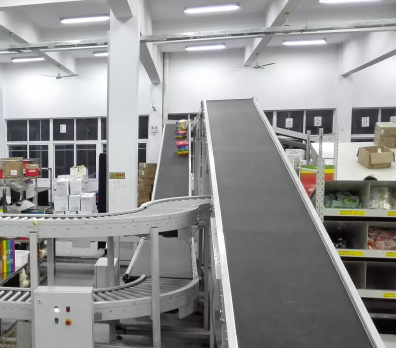
Selecting the right angle and load capacity for your inclined belt conveyor is crucial for ensuring smooth and efficient operation. A shallow incline may be suitable for lightweight items, while a steeper incline is necessary for bulkier or heavier goods. The optimal angle will help minimize material slippage and ensure that goods are transported without risk of damage.For instance, a 30-degree incline might be ideal for moving smaller items, while a 45-degree incline might be necessary for transporting larger loads. By choosing the right incline angle and load capacity, you ensure that your system is both efficient and safe for your specific needs.
Inclined conveyors can be equipped with various types of belts, including smooth, cleated, or chevron belts. The type of belt chosen will depend on the nature of the goods being transported. For example, cleated belts are ideal for preventing material slippage, especially on steeper inclines, while smooth belts are suitable for lighter, less fragile items.Additionally, sidewalls can be added to the belts to contain materials, providing extra security for items that might otherwise slide off the conveyor. Customizing the belt ensures that it meets the specific material handling needs of the warehouse.
Different types of goods require different conveyor configurations. For bulk materials, a cleated belt with sidewalls may be necessary to ensure that items are transported safely. For delicate items like electronics or glass, a smooth, low-speed incline conveyor may be preferred to avoid damaging the products during transport.Warehouse managers should work with conveyor system providers to customize the system for their specific needs, ensuring both safety and efficiency.
To ensure the safety of materials during transport, incline conveyors are often equipped with cleated belts or sidewalls. These features prevent items from slipping off the conveyor, even on steeper inclines. By securely containing materials, these safety features reduce the risk of accidents and product loss.By incorporating these safety mechanisms, inclined conveyors maintain smooth operations while preventing costly material damage.
Inclined conveyors are designed with various safety features to protect workers. These may include emergency stop mechanisms, guardrails, and automated sensors to detect obstructions. These features ensure that the system operates safely and that workers are protected from any potential hazards during operation.For example, sensors can detect if an object is blocking the conveyor, triggering an emergency stop to prevent damage or injury.
It is essential that incline conveyors meet industry safety standards and regulations. This ensures that the system operates within the required safety parameters and minimizes risks associated with material handling. Compliance with these standards not only ensures worker safety but also prevents potential legal issues.
Regular maintenance is crucial to ensure the longevity and reliability of incline conveyors. Routine tasks such as checking belt tension, cleaning components, and inspecting motors are essential for maintaining smooth operation. Proactive maintenance helps identify and resolve issues before they result in system failures.
Having a consistent maintenance schedule helps minimize unexpected downtime and prolongs the life of the conveyor system.
Effective maintenance reduces downtime by ensuring that the conveyor system is always in optimal working condition. By scheduling regular inspections and addressing potential issues early, warehouses can minimize interruptions in their operations, keeping goods moving efficiently.
With minimal downtime, warehouses can maintain a consistent flow of goods, ensuring that production and distribution processes are not delayed.
Investing in quality incline conveyors and proper maintenance practices can lead to long-term savings. High-quality components reduce the need for frequent repairs, while regular maintenance ensures the system remains efficient, reducing costly downtime.
Maintenance Task | Frequency | Importance |
Belt Tension Check | Monthly | Prevents slippage and wear |
Cleaning Components | Weekly | Ensures smooth operation and longevity |
Motor Inspection | Quarterly | Reduces risk of unexpected breakdowns |
Lubrication | Biannually | Keeps moving parts in optimal condition |
Belt Replacement | As Needed | Maintains material handling efficiency |
Incline conveyors are essential for optimizing warehouse operations. They improve space efficiency, material flow, and reduce manual handling. Customizing these conveyors ensures materials are moved safely and efficiently across multiple levels.By selecting the right incline conveyor system, businesses can boost productivity, enhance safety, and cut energy consumption. For unique warehouse needs, customized incline conveyor solutions are an excellent investment to streamline operations.
Inclined conveyors, with their tailored features, provide value by enhancing workflow and reducing space usage. Zhejiang Rigor Logistics Technology Co., Ltd. offers reliable conveyor solutions to meet diverse warehouse requirements, ensuring maximum efficiency.
A: An inclined belt conveyor is a system used to transport materials between different elevations, optimizing vertical space in warehouses.
A: They save floor space, streamline material flow, and reduce manual labor, making operations more efficient and cost-effective.
A: Yes, inclined belt conveyors can be customized in length, angle, and speed to fit unique warehouse layouts and handling requirements.
A: They provide space-saving solutions, improve material flow, reduce energy consumption, and enhance productivity by automating transport.
A: Inclined belt conveyors consume less energy compared to traditional vertical transport systems, helping reduce operational costs.


